Articles tagged with internet

Chuck vs. Fire from Olympus

posted by mcneil on Wednesday, January 20th, 2010 at 10:01am

“Knowledge is power.”

Sir Francis Bacon

“Now you’re playing with power.”

R.O.B.

Since the beginnings of Western civilization, we have understood that knowledge, like freedom, isn’t free.  While we respect the time and effort it takes to learn, we long for a shortcut, a free sandwich from the lunch lady of the mind.  Because it takes so long to acquire and because time is #1 on the list of finite resources, knowledge has always had value. Since the invention of writing, however, that value has been in decline. Thanks to modern technologies, individual facts are worth their weight in Zimbabwean dollars in today’s market.  That devaluation has changed the way we work, the way we learn, and most importantly on a site about pop culture, the way we tell stories.

Ancient astronomers spent decades memorizing the sky.  Their ability to predict eclipses, equinoxes and such made these men high priests.  Then we invented writing, and suddenly, those young whippersnapper priests were spending their nights sitting on the couch, watching the latest episode of Gilgamesh, trusting in written sources for their sacrifices instead of the uphill-both-ways astronomy of their elders.   A couple of thousand years later, Guttenberg opened up the whole deal to the plebians and suddenly, knowledge is off the gold standard.

“Books were prohibitively expensive in the so-called ‘good old days.’ In colonial America, in 1760, a cheap schoolbook cost twice as much as a good pair of leather shoes; Smollett’s Complete History of England cost as much as eighty pairs of shoes, six head of cattle, or thirty hogs. An ordinary laborer had to work two days to earn enough money to buy the cheap schoolbook, or 144 days to buy the Smollett. The modern innovations of mass production and marketing have brought down the cost of a paperback to only slightly more than the American minimum wage.”

–Tyler Cowen, In Praise of Commercial Culture, p. 52

These days, whatever the RIAA says, information is free.  Google, Napster, Wikipedia and friends put all the world’s data on the internet and iPhone gave us free* and instant access to that information anytime and anywhere.

At lunch with a guy/girl who’s into Iraqi history? 10 seconds from now you can show her the Gilgamesh story in the original cuneiform.

Out for a fancy dinner that night and want to impress him/her with your knowledge of the stars?  There’s an app for that.

Can’t think of any good pillow talk?  Talk about the implications to society of the fact that the iPhone can now solve a Rubik’s Cube.

Now that your date’s over, we’re here to talk about pop culture, so let’s move on and take a look at how knowledge has been treated in our stories.

New (Fake) Facebook Features

posted by Matthew Belinkie on Thursday, August 13th, 2009 at 11:45am

INT. FACEBOOK OFFICE

A 12-year-old boy sits behind a desk.

BOY: Hi there. I’m Mark Zuckerberg, founder of Facebook. I wanted to tell you about some of the exciting new features we’ll be rolling out in the coming months. You guys have enjoyed the “Poke” since the beginning. In 2007, we added the Super Poke. But for those times you really want to get somebody’s attention, we’re introducing the Ultra Poke.

Cultural Sensitivity McFail

posted by Matthew Belinkie on Thursday, June 18th, 2009 at 7:14am

McTree

I once heard a story… “Whatever blooms from the Baobab is given back to the earth, because the mighty tree never forgets its roots.” Like the mighty Baobab, McDonald’s and I will not be moved.

You’re not going to believe this, but the statement above is a direct quotation from the official McDonald’s website. First of all, it makes no sense. The tree gives back to the earth, and the speaker “will not be moved.” I don’t really get the analogy. And I really don’t get how McDonald’s factors into it. Does McDonald’s give back to the earth? Is McDonald’s impossible to move? Here’s my best shot: McDonald’s gives the speaker the strength of a mighty tree. But it’s certainly a confusing way to put it, not to mention a silly thing to say. Not only that, McDonald’s is equating itself with one of the most sacred trees in African folklore, known as “the tree of life.” That seems sort of disrespectful to the culture they’re pandering to, and gloriously ironic given how unhealthy McDonald’s food is and the high rate of obesity among African-Americans.

So basically, it’s not the best two sentences of marketing copy ever written. But the Baobab quote is merely the gateway to something even stranger: 365black.com, McDonald’s special website for black people. I promise you this is real.

Popular Culture We’re Taking For Granted

posted by lee on Wednesday, November 26th, 2008 at 7:56am

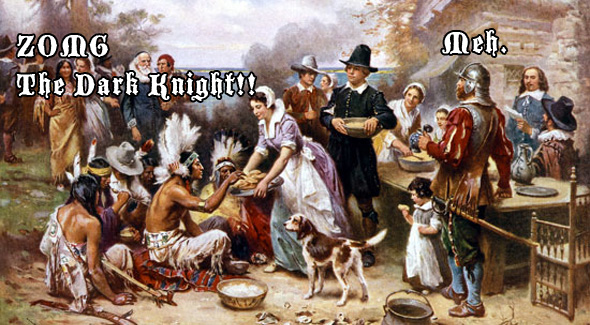
Happy Thanksgiving from Overthinking It! We know, there’s plenty of popular culture to be thankful for, but in the spirit of Overthinking It, I though I’d put a slightly different spin on giving thanks. Let’s take a look at the latest trends in popular culture that we should be thankful for, but now just accept as the norm. Dig in for a three-course Overthinking It Thanksgiving Feast after the jump (warning: Synecdoche, New York spoiler follows).

Convicted felon Ted Stevens has lost his re-election bid for the Alaska Senate seat which he held for the last, oh, eleventy-hundred years. While in the Senate, Stevens gained notoriety for bringing home epic quantities of pork barrel projects, being convicted of a felony, and, how could we forget, comparing the Internet to a series of tubes during a debate on Net Neutrality legislation:

They want to deliver vast amounts of information over the internet. And again, the internet is not something you just dump something on. It’s not a truck. It’s a series of tubes. And if you don’t understand those tubes can be filled and if they are filled, when you put your message in, it gets in line and its going to be delayed by anyone that puts into that tube enormous amounts of material, enormous amounts of material.

But now that Alaskans have routed him from office by a whopping 3,724 vote margin, we must now deal with the aftermath of his absence from the Senate.

The Internet is no longer a series of tubes.

Just as Alaska has moved on and found another Senator, we, too must move on and find another ridiculously inaccurate characterization for the Internet. Help me out after the jump:

Seriously Google, It’s Time

posted by Matthew Belinkie on Tuesday, October 7th, 2008 at 2:20pm

Gmail launched in March of 2004. That means that the service has been up and running for longer than the entirety of World War II American involvement in World War II. It now has tens of millions of users.

Google – it’s time to lose the “beta” tag.

(Yeah, I bet all you guys forgot that was still up there.)

According to Wikipedia:

Betaware is a nickname for software which has passed the alpha testing stage of development and has been released to a limited amount of users for software testing before its official release.

Insisting that a wildly successful full-featured website is still in beta is like saying, “Oh, this old site? It’s okay, I guess. One day it’ll be good enough so that we can stop being ashamed of it.” It’s the web design equivalent of showboating.

Let me ask you guys, is it possible that nobody over there is aware they still have the word “beta” up there? Maybe if it was pointed out to them, they’d be like, “Whoa, didn’t Roberts take that down last year?” “Me?! I thought you took it down!” “Well, let me just open up Photoshop here… okay problem solved. Thanks!”

UPDATE: This post originally said that gmail had existed for longer than “the entirety of World War II.” This is not in fact the case. The error has been corrected, and its author forced to watched all of that Ken Burns documentary.

The Word Cloud Conspiracy

posted by Matthew Belinkie on Thursday, August 28th, 2008 at 7:13pm

One of my many vices is political blogs. I read a whole slew of them, several times a day (and lord help me, I even read the comments). I especially enjoy reading the progressive DailyKos, and the staunchly conservative RedState, to get two different perspectives.

So when they both publish nearly identical posts, the hairs on the back of my neck stand up.

Best of the Blogs: The Harvard Classics Project

posted by Matthew Belinkie on Saturday, June 7th, 2008 at 10:21am

The Harvard Classics Project is a very Overthinking It-type enterprise, in that it combines high culture and pop culture.

On the high culture side is The Harvard Classics. In the first decade of the 20th century, Harvard President Charles Eliot claimed that a five-foot shelf of books could provide “a good substitute for a liberal education in youth to anyone who would read them with devotion, even if he could spare but fifteen minutes a day for reading.” (Which leads me to wonder, was President Eliot implying four years of Harvard was a pointless waste of time and money?)