posted by sheely on Monday, August 17th, 2009 at 6:29am
Originally, the OTI editorial staff was going to make this a break week for the Overthinking Lost series, as Mlawski is on vacation. However, rather than finding out what happens when we let the clock reach zero, I decided to race to my computer and punch in the numbers.
In addition, it has been a while since I have Overthought anything, so I saw this as the perfect opportunity for me to go back to the island.
Now might be a pretty good time (or in fact a bit too late for some readers) to mention that I’m going to depart from Mlawski’s cardinal rule—there will be substantial Lost spoilers in this post, so only read on if you’ve watched through the end of season 5 or don’t mind learning things that will substantially bias your viewing experience of the whole series thus far. There will also be major spoilers for The Wire.
Why would I gleefully break protocol after you’ve all been so careful not to reveal any of Lost’s big mysteries in the comments for the past few months?
Because I’m special—the rules don’t apply to me.
[Ed. Note: Seriously. There are substantialLost spoilers after the jump, up to and including everything that has aired. And pretty substantial spoilers for The Wire as well, covering the whole series. Don't read on if you're not prepared.]
posted by Think Tank on Friday, July 10th, 2009 at 9:04am
[This week, the Think Tank tackles a seminal work of 1980's literature: the lyrics to Bon Jovi's "Livin' on a Prayer." Stay tuned next week for music theory analysis.]
Literary Theory, Mlawski Knowing nothing about music theory and unable to come up with anything of note to say about “Living on a Prayer” as poetry, I’ve decided to complete an assignment I once had to do when I was getting my masters in English education. It’s… the literary theory assignment! Behold!
Living on a Prayer, the New Criticism reading: The lyrics start with the claim that this story happened “once upon a time, not so long ago,” which is our cue to read the text as a modern day fairytale. What happens in the text itself, however, is not the stuff of fairytale at all. “Tommy,” our dock-worker, is no knight in shining armor, though he tries to be by putting his six-string in hock. But, like Prince Charming in the fairy stories of old, Tommy does represent Everyman, the ideal. Likewise, “Gina” is no princess, but she is indeed a damsel in distress, the Everywoman in need of protection. Thus, the “once upon a time” introduction to the song is meant to be a somewhat ironic reference that suggests that “Living on a Prayer” is at once a fairytale and something of a satire of one.
posted by mlawski on Monday, May 4th, 2009 at 7:20am
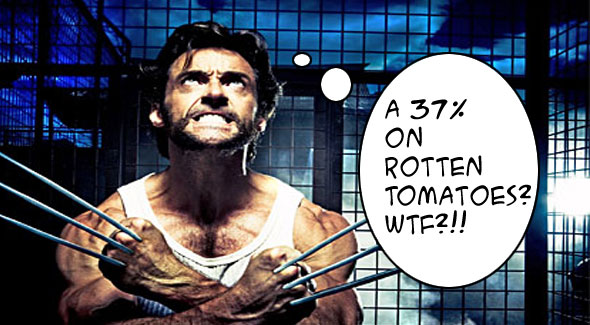
Before the first X-Men film, Wolverine was a backup dancer for Madonna.
It’s spring now in New York. The sun is shining, the birds are singing, the swine flu is mutating… It’s a time to be positive. After all, as that old poem said, April is the coolest month, and May is also rad.
So many “nos.” How about a “yes” for once? So, today, when I thought I might write a post entitled, “No More Prequels!” I held back. Instead, I bring you, “More Prequels, Please!”
And why shouldn’t there be more prequels? Just because almosteveryprequelevermade has disappointed, that doesn’t mean we should write off the whole genre! Today, I’m not going to just complain. I’m going to be positive, a fixer! Here are the three most common problems with prequels and how to fix them.
posted by sheely on Thursday, March 19th, 2009 at 7:53am
[The "Musical Talmud" is our ongoing series that finds the true meaning behind pop music lyrics. See also Part 1, "Don't Stop Believing," Part 2, "The KKK Took My Baby Away," Part 3, "I Want It That Way," Part 4, "Chinese Democracy," and Part 5 "Happy Xmas (War is Over)."]
Oh no, here it comes again
Cant remember when we came so close to love before
Hold on, good things never last
Nothings in the past, it always seems to come again
Again and again and again
Looking at these lyrics, it is tempting to infer that they are lifted straight from one of the 80s many monster ballads, or really any other romantic pop song. The sentiments are grand, the word choice is general, and love is mentioned in the second line, for chrissakes. However, this inference couldn’t be too much further from the truth- these lyrics are the opening line of “Neon Knights”, the lead track on Heaven and Hell, Black Sabbath’s first album after replacing Ozzy Osbourne with Ronnie James Dio in the late 70s. For those of you unfamiliar with Mr. Dio’s body of work, let’s just say he’s known for being heavy on the “Monster” and rather light on the “Ballad”. Here he is performing “Neon Knights” with Sabbath back in the 80s:
Based on the title, first verse, and one viewing of the video, it is tempting to dismiss “Neon Knights” as just another example of the excesses the dungeons and dragons wing of 1980s Heavy Metal. After all, Dio is the singer who Tenacious D idolizes/lampoons as the patron saint of singing songs about wildebeests and angels and soaring on the wings of a demon. However, if you stick with me after the jump, and I’ll show how Ronnie James Dio succeeds in transforming a four minute metal song into a treatise on the nature of social order.
posted by lee on Monday, March 16th, 2009 at 3:33pm
There is no future. There is no past. Do you see, bra? Time is simultaneous, an intricately structured jewel that humans insist on viewing one edge at a time, when the whole design is visible in every facet, bra.
posted by stokes on Monday, March 16th, 2009 at 8:33am
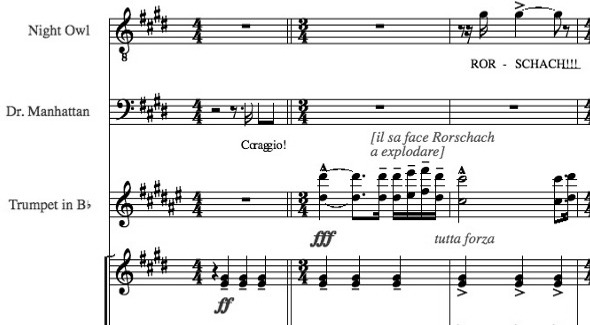
Tasha Robinson, over at the Onion’s AV Club, has an excellent piece up comparing the book and film versions of Watchmen. In addition to the obligatory laundry list of fannish greivances, she points out a crucial difference between the two versions that Snyder had no control over: comics are a medium of visual narrative, while film is a medium of audiovisual narrative. Robinson is talking about the actors’ performances, and she does a good job explaining the effects of that. But she doesn’t mention the other big part of the film’s soundscape: music. And that’s kind of a shame, because the music department did something really interesting here. (Our own Mlawski saw this coming, as devout OTIketeers will no doubt recall…)
Spoilers ahead, for what it’s worth. Though I doubt anyone would read this without having seen the movie anyway.
posted by Matthew Wrather on Monday, March 16th, 2009 at 12:49am
Mark Lee hosts as he, Matt Belinkie, and Josh McNeil overthink the Watchmen movie one last time (at least on the podcast), the Jim Cramer vs. John Jon Stewart showdown, and our Google Reader habits. Plus, Lee reveals a deep, dark secret from his past for the first time. (Feel free to flame him in the comments.)
Tell us what you think! Email podcast AT overthinkingit DOT com or call 20-EAT-LOG-01—that’s (203) 285-6401. And do us a favor and take the very short survey!
posted by Matthew Wrather on Sunday, March 8th, 2009 at 11:48pm
Matthew Wrather hosts a panel including Peter Fenzel, Joshua McNeil, David Shechner, and (drumroll) new OTI staff writer John Perich to overthink the Watchmen movie, which several of us have seen and all of us pontificate about, with minor digressions into Leonard Cohen and (of course) The Wire.
Tell us what you think! Email podcast AT overthinkingit DOT com or call 20-EAT-LOG-01… that’s (203) 285-6401. And do us a favor and take the very short survey!
posted by stokes on Saturday, March 7th, 2009 at 9:56am
Watchmen is the kind of work that invites interpretation. It has resonance with real-world political events and a tone of high moral seriousness, but no overt moral or political message. The formalist conceits are dazzling in their coquemplexity, but lack the clear symbolic significance of, say, the gimmick from Memento. So what does it all mean?
Probably every geek-in-good-standing has a theory, and your humble blogger is no exception. However, it’s entirely impossible that this isn’t the right question to be asking. As noted in a recent post, Watchmen has a reputation as a serious literary work. Words like “complex” and “difficult” get tossed around a lot, and not without cause. But if it is worthwhile for its “complexity,” then doesn’t it follow that providing the book with a moral is in a sense robbing it of the very thing that makes it special? In any case, crappy novels may have laudable messages, while many a masterpiece is appalling at it’s core. So when it comes to judging or explaining the value of Watchmen as a work of narrative art, its message is irrelevant at best.
And yet… and yet… the text is so mysterious on so many levels that it seems to cry out for exegesis. You have to be willing to entertain this sort of speculation if you’re going to engage with it at all: refusing to speculate about Watchmen is like refusing to laugh at a comedy.
So what does Watchmen mean? Beyond the jump, I’ll take up that question, but although I’ve thought hard about this, and I really do believe in the answers I’ve come up with, they remain as personal (and ultimately meaningless) as laughter. I’m sure that many of you reading this have interpretations of your own, and I hope you’ll laugh along with me by sharing them in the comments… that act of speculation, I think, is all that “really getting” the work entails.
One last thing: this is really only for people who’ve read it already. I will SPOIL the major Watchmen plot twist; what’s more I’m going to assume that everyone already knows the characters and plot. (Also it should be noted that this is about the Watchmen book. As of this writing, I haven’t seen the movie.)
posted by mlawski on Monday, March 2nd, 2009 at 8:19am
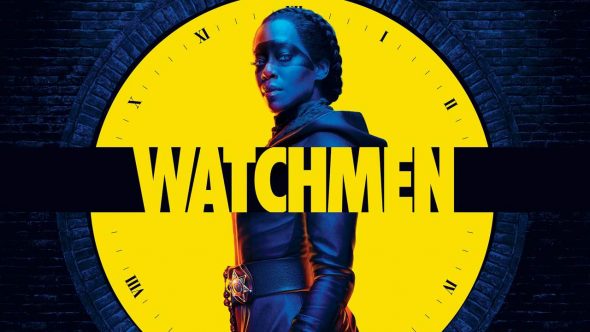
The Internet is abuzz! Watchmen is coming! Watchmen is coming! The early reviews are in: Variety hates it. The Times (UK) loves it. Kevin Smith thinks it’s a work of genius. The Hollywood Reporter says it’s the first flop of 2009.
What are we, the people, supposed to make of these wildly divergent reviews? How will we know if Watchmen is worth seeing or not?
The Overthinking It readers look up and shout ‘Help us, Mlawski!’
And I look down and whisper, ‘Okay.’
This Internet is afraid of me. I’ve seen its true face.