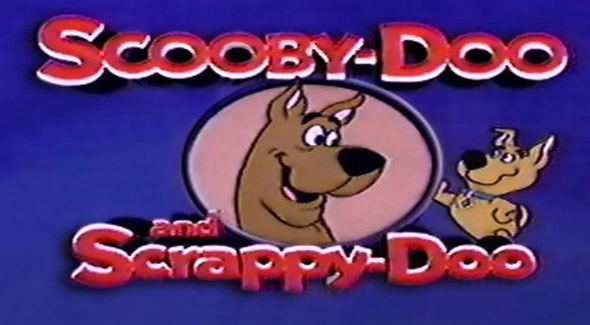
So I was talking with my boyfriend recently about Bandit–a.k.a. the dog from Jonny Quest, and don’t ask—when I had a curious thought. Why is it that we, as human TV-watchers and filmgoers, are perfectly fine with the fact that dogs in the media sometimes act like dogs and sometimes don’t? Seriously, am I the only one who finds this strange? Take Scooby Doo and Scrappy Doo, for example. It was weird enough when there was only Scooby, the dog who sometimes acted like a dog and sometimes acted like a person. This was a dude who would sometimes walk on four legs and sometimes on two, and we were fine with that. This was a dog who could speak English—not like Bugs Bunny can speak English, mind you, but some kind of bizarre pidgin English as approximated by a semi-sentient dog. And we were okay with this. I know I was.
But then what happened? Then, the geniuses behind the Scooby Doo machine threw a wrench into the cogs—and his name was Scrappy Doo. We were led to believe that the show was set in a universe in which dogs could kinda-sorta talk and kinda-sorta walk on two legs, and then here comes this new dog who speaks perfect English, without some kind of off-the-wall speech impediment, and how not only can walk and run on two legs, but who can box like a pro.
You would think that we, the audience, would have a problem with this. And some of us did. But you know what? I really didn’t. I accepted this. I never even justified it to myself by saying, “Oh, I see! In this universe, dogs do talk and act like perfect, hairy little humans. It’s just that Scooby is developmentally disabled. It all makes sense now!” No, I didn’t say anything like that at all when I was a child. I just said, “Huh, Scrappy can talk and Scooby can’t. I accept this without question!”
Well, I’m older now, and wiser, and I realize that not all TV dogs are made alike. But is there a way we could possibly categorize these canine critters? Like, say, in a chart?
As President Obama says, yes. Yes, we can.