Articles tagged with unmitigated pretension

Through the Player’s Eyes

posted by stokes on Thursday, August 6th, 2009 at 7:00am

I was reading an essay called “Art and Answerability” by Mikhail Bakhtin the other day, where he makes the claim that one of the most important differences between novels and dreams is that in novels, we see the main character from the outside.  And as so often happens when I’m ostensibly reading something for my real job, I immediately started thinking about how I could squeeze a blog post out of it.

With regard to literature and dreams, this statement of Bakhtin’s is one of those ideas that seems accurate, but can never be tested.  I’ve never heard of anyone having a dream where another person was the main character, but that doesn’t mean it can never happen (and I did once dream a non-representational laser light show, which was pretty weird), and even if it  never does happen, that doesn’t mean that this is an important differance.  And Choose Your Own Adventure books aside, there’s not a whole lot of novels out there that situate the reader as the experiencing subsect of the book.  Yes, rewriting The DaVinci Code in the second person might make it more dreamlike, but while writing in the second person might create a dreamlike effect, but it’s mostly just going to jump out at the reader as an affectation. It’s too unnatural to be taken seriously.  So pointing out that a narrative needs to depict its characters from the outside is accurate, but it’s also nigh-tautological, kind of like pointing out that the story needs to be made up of sentences and words.

That, at any rate, was the state of affairs when Bakhtin was writing.  Luckily, the times have now caught up with him, and we have a new form of narrative where both 2nd and 3rd person narration are common.  I’m talking about video games, and will continue to do so after the jump.

The Real (Symbolic, and Imaginary) Ghostbusters

posted by stokes on Tuesday, June 9th, 2009 at 6:44am

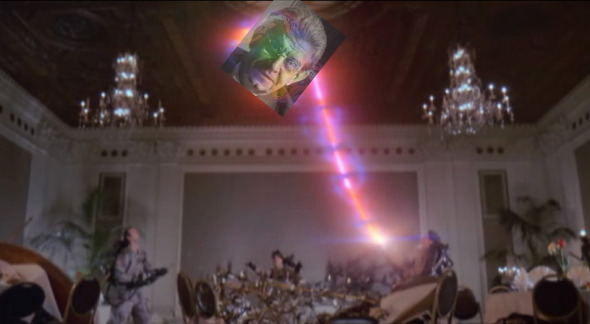
“The oldest and strongest emotion of mankind is fear, and the oldest and strongest kind of fear is fear of the unknown.”  So opens H.P. Lovecraft’s 1927 essay “Supernatural Horror in Literature.”  To quibble with Lovecraft about horror is surely a sucker’s game, but I think he’s only half right here.  Lovecraft’s own stories all have a central “unknown,” but the best and scariest of them are always the ones where the big reveal comes not as a shock but as a confirmation, not a “WTF?” but an “I knew it!”  So I’ll emend his definition:  The oldest and strongest kind of fear is fear of that unknown which we realize, in the moment of unveiling, that we knew all along.  Of course, it’s a tricky line to walk, which is why truly successful horror is such a rarity.  Telegraph it too much, and the audience will laugh at you.  Too little, and you end up with the Double Shyamalan, a twist ending that’s so out-of-left-field that the audience simply rejects it.  To get it right, you have to get your audience to realize the secret subconsciously while remaining consciously oblivious.  Now, I’m not going out on much of a limb by saying that the subconscious plays a role in horror.  Most scholarly analyses of horror claim that the supernatural unknown illustrates a Freudian concept known as “the return of the repressed.”  What the rational mind refuses to deal with – sexual desire being the big one, although in Lovecraft’s case it was racism – will bubble back up again as a bug-eyed monster.

Curious what all this has to do with Ghostbusters?  Me too!  Let’s click through to the next page together, friends.

Episode 42: What Art Ain’t

posted by Matthew Wrather on Monday, April 20th, 2009 at 12:05am

Matthew Wrather hosts as the panel (Matthew Belinkie, Peter Fenzel, and Mark Lee) overthink:

  • Crank truancy
  • Rage (the rage of Achilles, son of Peleus)
  • Pretending to be pretentious
  • Our Sean Connery impersonations
  • Dragonball
  • What Art Ain’t

Tell us what you think! Email us or call 20-EAT-LOG-01—that’s (203) 285-6401. If you haven’t yet, take the very short survey! And… spread the overthinking by forwarding this episode to a friend.

Download Episode 42 (MP3)

“Punishment, then, will tend to become the most hidden part of the penal process.  This has several consequences:  it leaves the domain of more or less everyday perception and enters that of the abstract consciousness; its effectiveness is seen as resulting from its inevitability, not from its visible intensity; it is the certainty of being punished and not the horrifying spectacle of public punishment that must discourage crime.”

This is Michel Foucault talking about the decline of torture and public execution as crime-deterrents in Europe at the beginning of the 19th century.  Now compare this with the current methods the record and film industry are using to deter piracy.  The likelihood that any single pirate will be caught is essentially nil, but the fines that are handed out – quite publicly, I might add – are pretty much the equivalent of being drawn and quartered.

What interests me is the next passage.  “… in punishment-as-spectacle a confused horror spread from the scaffold; it enveloped both executioner and condemned; and, although it was always ready to invert the shame inflicted on the victim into pity or glory, it often turned the legal violence of the executioner into shame.”  Which is why they wore those black hoods, naturally.

Now tell me that’s not how a file-sharing lawsuit works!  When we hear about a six-figure fine being dropped on some college kid or soccer mom, we have nothing but pity and sympathy for the defendents, and nothing but shocked disgust for the plaintiff.

My point here is not that the RIAA is a bunch of leather-masked gimps.  (Well, not only that.)  My point has to do with our legal system.  The shift away from the torture and execution model was motivated, says Foucault, by our acceptance of the “essentially corrective character” of the legal system.  Torturing someone to death won’t reform them.  It might scare someone else off, but it’s not going to reform anyone.  Once we started trying to reform criminals, public executions had to be abandoned.

In 21st century America, our penal code is essentially corrective.  Our civil code, the code that copyright offenses are prosecuted under, is not.  It operates under the older – and crueler – principle of of an eye for an eye.  The punishment is not intended to serve the greater public good.  Neither does it repair the material harm caused by piracy (which is how civil suits are supposed to work).  It is a vehicle of catharsis, an opportunity for the wronged coporate entity to express its righteous indignation.  No more, and no less.

p.s.  Informed readers will note that all my quotes are taken from the first, like, nine pages of Discipline and Punish.  To which I respond… shut up.  I’m busy, ok?  I’ll read the rest of it eventually.

Fictional Fictions

posted by stokes on Wednesday, October 8th, 2008 at 7:24am

Never again will the real have the chance to produce itself — such is the vital function of the model in a system of death, or rather of anticipated resurrection, that no longer even gives the event of death a chance.

–Jean Baudrillard

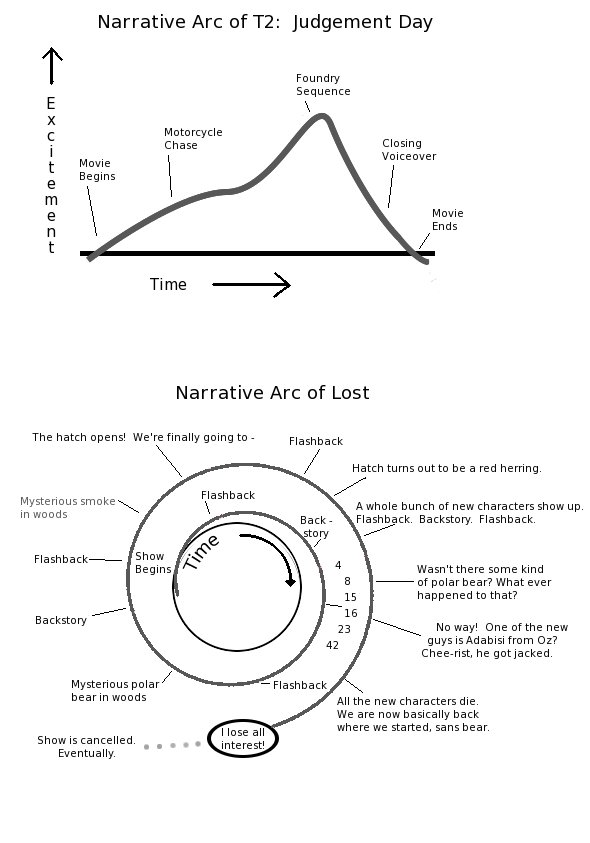
Let’s play a game:  I’m going to say something ridiculous, just for the fun of it.  Okay, here goes.  “The Terminator franchise will come to an end with the upcoming Christian Bale movie, Terminator: Salvation.  It will be the very last Terminator story ever told in any medium; the franchise will die when the credits roll.”

So why is that so absurd?  Obviously a franchise is endlessly renewable as long as a corporate entity believes the property has value, and yet franchises do die.  There is nothing inherently ridiculous about the claim that there will not be another Ghostbusters movie.  The two that already exist present us with closed narrative forms, both individually and as a unit.  If another Ghostbusters movie were to be created, it would be a resurrection of a dead property.  The same is not true of the Terminator, which, as of the Sarah Connor Chronicles, exists outside of time.