Articles tagged with stanley kubrick

Michael Bay: A Quantitative Comparative Analysis

posted by lee on Tuesday, June 30th, 2009 at 9:54am
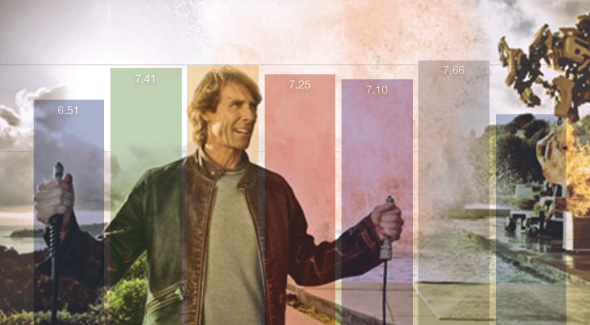
Official Poster for Michael Bay Hate-fest 2009

Official Poster for Michael Bay Hate-fest 2009, aka ZOMG OPTIMUS PRIME

Transformers: Revenge of the Fallen has arrived in theaters, and to no one’s surprise, Michael Bay has stayed true to form and given us a loud, action-packed summer blockbuster. Also to no one’s surprise, critics have savaged his latest work: the Rotten Tomatoes aggregated review score comes in at a meager 20%. And again, to no one’s surprise, the idiot savants of the blogosphere have, as if by reflex, piled on the Bay hate and lampooned his heavy handed filmmaking techniques and lack of sophistication.

The Overthinkers are by and large of the same opinion: we see Michael Bay movies as the epitome of style over substance, cleavage over character development, and explosions over elegance. He does make a convenient whipping boy for the shortcomings of mainstream commercial cinema these days, and as such he’s been the butt of jokes on several occasions on this site.

That being said, I’d like to use this occation, the release of Bay’s latest fil…er, movie, to take a step back and examine his body of work more objectively. How bad is Michael Bay, really? And how does he compare to some of the greatest directors of our time?

As you’re probably aware, almost any effort to objectively analyze the inherently subjective nature of movie quality involves turning to the vast database of user ratings on IMDb. It’s an imperfect methodology, I know, but it’s better than nothing. This is not the time to argue the merits and meanings of the IMDb user ratings (if you’re interested in such things, you should probably check out this earlier piece of analysis on the topic). This is time to take the data we do have, fire up the Excel, and get to work.

[Note: all IMDb ratings used in this article are current as of June 29, 2009]

Think Tank

Eyes front, you maggots!

In this special Memorial Day Weekend Think Tank, Overthinking It takes a moment to honor the fictional sacrifices that fictional soldiers have made to defend our fictional country against its fictional foes.

But these noble heroes could not have made the sacrifices they did without a firm hand to guide them. Someone who was cruel to be kind. Someone who bitched them out like a New Orleans pimp but loved them like a father.

We’re talking about the king of the non-commissioned officers: the sergeant.

This week’s Think Tank: who is the best movie, TV, video game, cartoon, music or comic book sergeant?

Thanks for visiting Overthinking It, where we take movies, tv, music, comics, and videogames waaaaay too seriously.

While you’re here, check out our other articles, or just the ones about movies.

And check out our podcast (iTunes link).

If you like what you read, you can get all the latest posts by RSS or by email.

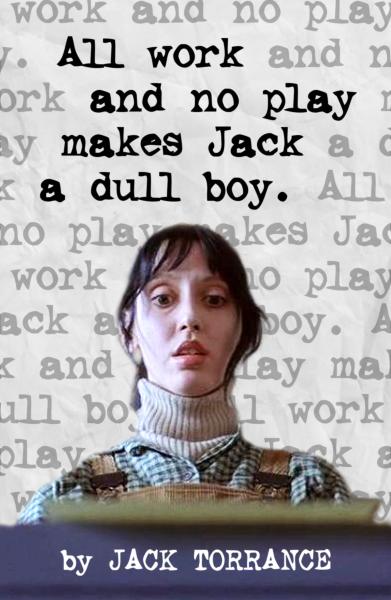
I have just finished All Work and No Play Makes Jack a Dull Boy, the debut novel by the late Jack Torrance, and I do not hesitate to call it the greatest English work of the past 50 years. It is nothing short of a complete rethinking of what a novel can and should be.

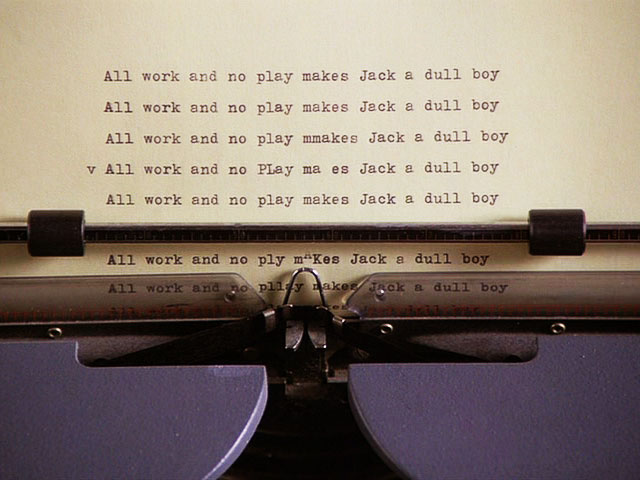
At the risk of spoiling the book, let me repeat what you may well have heard from the tabloid press and late-night comedians. All Work consists of a single sentence, repeated over and over for hundreds of pages. Some will dismiss it as simplistic; that’s like dismissing a Pollack canvas as mere splatters of paint.

It’s true that, taken on its own, All Work is plotless. But like the best of Beckett, the lack of forward momentum is precisely the point. If it’s nearly impossible to read, let us take a moment to consider how difficult it must have been to write. One is forced to consider the author, heroically pitting himself against the Sisyphusean sentence. It’s that metatextual struggle of Man vs. Typewriter that gives this book its spellbinding power.

Sadly, Mr. Torrance’s legacy has been tarnished by his widow. The couple and their young son spent the last winter of his life as caretakers of a remote mountain resort, where he put his masterpiece to paper. Mrs. Torrance has claimed that he tried to kill her and the boy in a fit of madness. Personally, I believe she is the real murderer. Mr. Torrance was found frozen to death in a hedge maze, days after his wife and son abandoned him. I find it likely that this betrayal drove him, if not to suicide, then at least to ignore his own safety during a treacherous Colorado snowstorm.

Thankfully, Mr. Torrance was able to complete All Work before his untimely death. (Although truthfully, the book’s unconventional nature makes it difficult to say whether it’s “complete” or not.) For most of his adult life, Torrance has worked as a teacher, his genius going to waste. Call it poetic justice that the resort at which he became an author is called the “Overlook Hotel.”

All Work out-moderns modernism. It surpasses post-modernism. I can only refer to it as “most-modernism.” I could easily write thousands of words on Mr. Torrance’s accomplishment, but I’ll heed the book’s advice and end my work here. Suffice to say, All Work and No Play Makes Jack A Dull Boy is a shining achievement.