Articles tagged with nintendo

Shrooms of Power: Who Really Rules the Mushroom World?

posted by Guest Writer on Friday, August 21st, 2009 at 7:01am

New guest writer Kevin Johnson asks: How widespread is the Toadstool dynasty?

Princess ToadstoolShe was Princess Toadstool at first. When Super Mario Land was released, there was a bit of confusion over whether Daisy and Princess Toadstool were the same. The crappy movie implied that they were, but Nintendo pretty much laid that to rest. When they brought the Peach name over from Japan, Peach and Daisy officially became two different people, and two different leaders.

Though the actual identities have been cleared up, the connotation of the “Toadstool” name is another matter. How do the inhabitants of the Mushroom World view the Toadstool crown? What does it evoke, and more importantly, how significant is the name Toadstool throughout the regions? In other words, how much power and influence does Princess Toadstool really have over the lands around her?

Tri-Forced

posted by Guest Writer on Wednesday, August 12th, 2009 at 1:43pm

Enjoy today’s guest post by Chris Richards: some much-needed Overthink on the Legend of Zelda series. If you like it, or even if you think it’s out there, sound off in the comments!

Over the last three decades, there are few videogame franchises that maintain their marketing tour-de-force for longer than a few years. Halo has dimmed, Mario is no longer a staple of every game-based living room, and poor Sonic doesn’t even have a system anymore (or any real following that doesn’t rely on nostalgia…and even Stretch Armstrong can sell via nostalgia). But one franchise that has endured, and has actually grown in prominence, is The Legend of Zelda.

When the first game came out, it was popular enough, to be sure. But it wasn’t THE game. Mario Bros. 3 certainly sold more cartridges. But, over the years, the Zelda cult has grown to the point that its
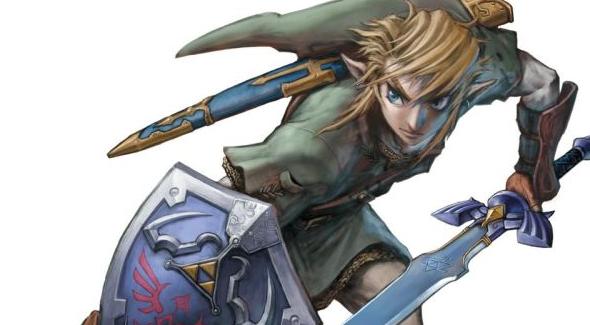
hero, Link, is now more important in launching Nintendo hardware than Mario. Pretty impressive for a semi- androgynous, poor-and-uneducated, forest farmboy.

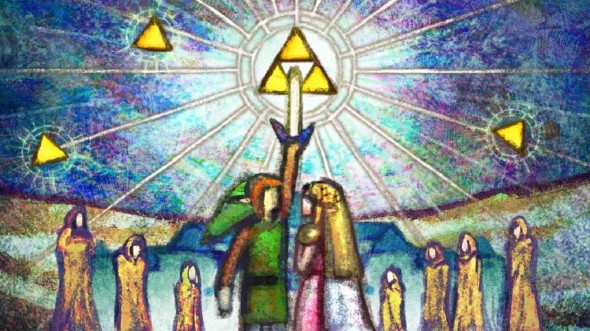
At the center of the whole series is a mystical artifact called the Triforce, a triangle-shaped golden MacGuffin of amazing power and influence (which we see little of, really). The Triforce was given to
the people of Hyrule by the Three Gods, Din, Nayru, and Farore, and contains their purified essence. After all the hoopla over the thing, you’d think that it would really be world-changing, like the One Ring or The Box of Ordon or Two Tickets of Transit. But no, the Triforce not only fails to live up to the hype, it also fails to live up to its own description. For the sake of this argument, I’m basing my arguments on The Ocarina of Time, but most of the Zelda games are just retelling the same story with new inconsistencies (there is no
Triforce of Plot Coherence)

Super Smash Bible

posted by fenzel on Wednesday, July 15th, 2009 at 9:14am

I’ve been playing a lot of Super Smash Brothers: Brawl lately, and I played Super Smash Brothers Melee religiously for years (at least, wow six or seven years by now).

Religiously, hm?

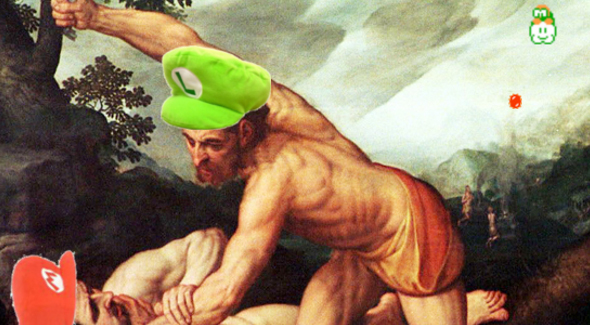
It's a me! Pentecost!

It's-a me! Pentecost!

At the heart of Super Smash Brothers is solid gameplay, but on the surface is misplaced familiarity. Take something that doesn’t belong in a fighting game, put it in a fighting game, and suddenly there are all sorts of unintended joys. It took everybody a while to warm up to the Tekken guys (and I, frankly, still haven’t), but there’s a sincere pleasure to playing with these familiar characters as they fight. It’s the sort of fantasy that’s always part of the artistic imagination. It worked for tennis, it worked for golf, it worked for paper, it worked for karts — when you shoehorn in Nintendo characters, the game becomes more familiar, more interesting and more fun.

Shoehorning, hm?

More fun, hm?

What follows is an experiment . . .  can the Smash Brothers principle make anything fun? How much of the original shines through, and how much is just nonsense? Can it spice up something that’s solid at its core, but could definitely gain something from being more familiar, more interesting and more fun . . .

. . . like the King James Bible?

The Greatest Story in the History of Video Games

posted by stokes on Monday, April 13th, 2009 at 8:23am

Videogames lead a strange dual life.  On the one hand, we have what some writers have labelled the Ludic element, that is, the game as a pure game, a  systems of rules which can be manipulated, interacted with, mastered, and won.  On the other, you have narrative, a concept with which I assume you all are familiar.  Most pre-electronic games are purely ludic (chess pieces lack interiority).  Toys, on the other hand, encourage narrative:  you cannot win at dolls, but you can tell hella stories about them if you like.  Videogames tend to combine the two, at least to some extent.

Different genres have different relationships with narrative. On the high end, you have RPGs, which require gobs of it.  Platformers usually just have a sentence or two, like “Our Princess is in Another Castle” or “BANG! End of Rescue Attempt.”  Sports games are usually narrative-free… except for fighting games, which usually require a rudimentary sense of plot and character. (I’m sure many of us have fond memories of the geopolitical intrigue of Street Fighter II, or the overheated soap opera of Dead or Alive, or Little Mac’s boxing journey through the land of racist stereotypes.) And it is a fighting game that provides us with the boldest and strangest narrative in the history of gaming. I’m talking, of course, about Super Smash Brothers for the N64.

The Darkest Ending in Video Game History

posted by Matthew Belinkie on Wednesday, December 17th, 2008 at 10:13am

Anyone who grew up with a controller in his sweaty little hands had at least one moment when a video game touched him emotionally. For some people, it was Sephiroth turning your girlfriend into a shishkabob. For others, it was Snake visiting Arlington Cemetery. But my most mind-blowing gaming experience was when I beat the Double Dragon arcade machine.

Actually, scratch that. I finished it; I don’t think I really beat it.

It was my freshman year of college. One rainy Saturday afternoon, my roommate Joe and I were contemplating the possibility of doing some actual work. Instead, we headed to Cutler’s Records, which had a row of classic arcade machines in the back. Our plan was to use only three dollars in quarters to win Double Dragon (and possibly pick up the new Britney Spears album while we were there).

We watched as the lovely Marian was gut-punched and dragged away by the Black Warriors. Then a garage opened and our two protagonists emerged: Billy and Jimmy, karate masters with tempers as fiery as their mullets. Joe and I cracked our knuckles and proceeded to crack dozens of digital skulls. The fighting raged through the city streets, a factory, a forest, and finally the headquarters of the street gang, which appeared to be some sort of Pagan temple.

Joe and I weren’t particularly adept, and the quarters balancing on the screen started to disappear at an alarming rate. But finally, we entered a room and saw Marian chained to the wall. At this point, we were low on health and cheering each other on loudly enough to scare everyone out of the World Music section of the store, which was probably just as well. A couple of jump kicks later, the last bad guy hit the floor and disappeared. We’d won.

Then, we saw this…