Articles tagged with marxism

Phallic Mr. Fox

posted by mlawski on Monday, November 30th, 2009 at 7:00am

fantastic-mr-fox-posterLet’s get this out of the way first.  Fantastic Mr. Fox is about penises.

There.  I said it.  Fantastic Mr. Fox is about penises, and there’s nothing you can say to convince me otherwise.  Look, I had wanted to start this post with a really good, academic-style introduction about the relationship of Wes Anderson’s new film with the works of postmodernist Don DeLillo.  Then I thought, No, I should start by talking about Marxist notions of proletarian alienation.  Then I thought, No, actually, the Durkheimian concept of anomie might be more appropriate in this context.

But these subjects, while related to the following article, are mere branches growing off the main shaft of this post.  The long and short of it is, this post is about penises.  Say it with me, kids.  Fantastic Mr. Fox is about penises.

Now that that’s out of the way, let’s let out a deep breath and do some overthinking.

Episode 71: War on Cold

posted by Matthew Wrather on Monday, November 9th, 2009 at 1:05am

Matthew Wrather hosts with Peter Fenzel, Mark Lee, Josh McNeil and Jordan Stokes to overthink cold war pop culture in light of the twentieth anniversary of the fall of the Berlin Wall. There is a characteristically unaccountable digression about the repatriation of antiquities to Egypt.

Tell us what you think! Leave a comment, use the contact form, email us or call 20-EAT-LOG-01—that’s (203) 285-6401.

Download Episode 71 (MP3)

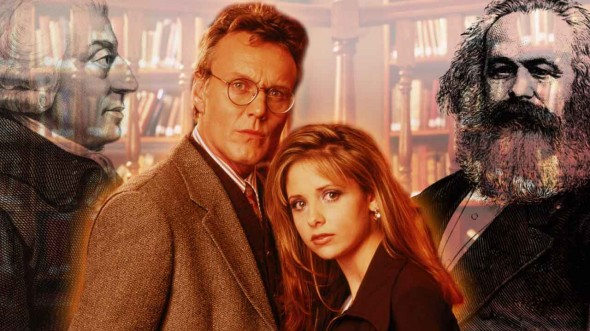
Karl Marx: Even harier than the Wolfman.  Coincidence... OR IS IT!?

Karl Marx: Even hairier than the Wolfman. Coincidence... OR IS IT!?

[I want to thank Professor David Graeber, whose anthropological dissection of Buffy the Vampire Slayer (and accompanying lectures) very much forms the basis of this post.]

Let’s begin with two observations. First: the Vampires that inhabit our most recent pop cultural works differ so dramatically from the classic archetype of Golden-Age Hollywood that they are are almost unrecognizable. Second: Werewolves are lame.

Or at least, compared with their undead, blood-sucking, vaguely-Carpathian cohort, werewolves of late have occupied a far less enviable position in the collective pop cultural landscape. These are not the subtle, nuanced, infinitely malleable characters vampires are–the sort capable of carrying their own novels, TV-shows, Movies and crappy Movie-Tie-In Video Games. Rather, lycanthropes end up as the stock types passively added to spice up a Vampire vehicle. Sure, some immortal genius might figure out a way to breathe new life into the old dogs, but for now, Buffy’s Oz remains a werewolf’s best case scenario. In the worst cases it’s… well… I’d rather not say.

However, there is something to be said about the sheer frequency with which werewolves pop up in Vampire works. Is your horror-story turned teen-abstinence-parable getting a bit too stale to survive a sequel? Throw in some werewolves! Is having a psychic heroine dating a vampire proving an insufficient allegory for southern race relations? Make her boss a werewolf! At least…sorta’. The point is, as the length of a Vampire epic approaches infinity, the probability that the spinning “let’s throw in a different kind of monster” wheel will stop on “Werewolf” approaches 1. And it does so far earlier than all of the other forms. As the old aphorism goes: no ghosts, witches, reanimated corpses, mer-people, vengeful pagan gods or giant, radioactive slugs before werewolves. And for heaven’s sake, NO MUMMIES.

The delicious exception that proves the rule.

The delicious exception that proves the rule.

Yet–and this is important–despite the number of appearances Werewolves (or the equivalent) make in predominantly Vampire (or equivalent) works, the converse is never true, because Werewolves remain lame.

But why? What is it about our culture that causes us to perpetually dwell on one classic occult figure, while paupering the other of such attention?

The answer, of course, lies in the failure of Marxism.

[This week, the Think Tank tackles a seminal work of 1980's literature: the lyrics to Bon Jovi's "Livin' on a Prayer." Stay tuned next week for music theory analysis.]

bonjovithinktank

Literary Theory, Mlawski
researchKnowing nothing about music theory and unable to come up with anything of note to say about “Living on a Prayer” as poetry, I’ve decided to complete an assignment I once had to do when I was getting my masters in English education.  It’s… the literary theory assignment!  Behold!

Living on a Prayer, the New Criticism reading: The lyrics start with the claim that this story happened “once upon a time, not so long ago,” which is our cue to read the text as a modern day fairytale.  What happens in the text itself, however, is not the stuff of fairytale at all.  “Tommy,” our dock-worker, is no knight in shining armor, though he tries to be by putting his six-string in hock.  But, like Prince Charming in the fairy stories of old, Tommy does represent Everyman, the ideal.  Likewise, “Gina” is no princess, but she is indeed a damsel in distress, the Everywoman in need of protection.  Thus, the “once upon a time” introduction to the song is meant to be a somewhat ironic reference that suggests that “Living on a Prayer” is at once a fairytale and something of a satire of one.