Articles tagged with ghostbusters week

The Ghostbusters’ Risky Business Plan

posted by lee on Saturday, June 13th, 2009 at 1:50pm
Who you gonna call?

Who you gonna call?

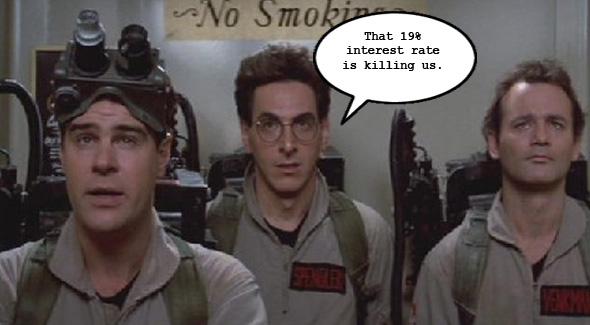
The Ghostbusters had a problem. They needed substantial start up funds to cover the cost of containment units, proton packs, the receptionist Janine’s salary, and other business expenses.

Who you gonna call?

Your local easy-lending mortgage bank!

VENKMAN
You’ll never gonna regret this, Ray.

STANTZ
(perturbed)
My parents left me that house, I was born there.

VENKMAN
You’re not going to lose the house.
Everybody has three mortgages these days.

STANTZ
But at nineteen percent–you didn’t
even bargain with the guy.

SPENGLER
(calculating)
Ray, for your information, the interest
rate alone for the first five years comes
to $95,000.

The Ghostbusters, it would seem, were not particularly financially savvy. In fact, it’s a miracle they didn’t run out of cash shortly after starting up.

And the Ghosts Busted On: Ghostbusters and the AIDS Crisis

posted by Guest Writer on Friday, June 12th, 2009 at 6:56am

Ghostbusters Week[Ghostbusters Week continues with a guest post by André Callot.]

It’s 1989, and there is a crisis in New York City. The red goo that flows through the heart of the city is infected with a deadly contagion. Spreading out from the center of the arts community, this circulating liquid can fill you with life energy, or it can fill you with evil. This plague turns normal people into walking ghosts so hideous that people on the street shriek in terror at the sight. The city, tainted with fear, hatred and prejudice, is divided against itself. Scientists and activists work to stop the spread, but everywhere they turn, they face the resistance of a city that is unwilling to even acknowledge the problem, a city that stigmatizes those brave enough to fight for public safety.

It seems as though this sickness is, at its heart, an expression of the festering anger permeating a dying city.

Let me tell you something: Overthinkin’ makes me feel good

posted by stokes on Thursday, June 11th, 2009 at 11:56am

No Ghostbusters Week could be complete without at least a passing mention of Ray Parker Jr.’s 1984 hit “Theme from Ghostbusters.”

We all know this song—it’s possibly the single most recognizable movie theme song in history—but some of us may not know the inexplicable music video, which is about a woman whose glowing neon house is apparently haunted by the disembodied heads of Chevy Chase and Danny DeVito.  Spooooooky!

(BTW, let me just point out that there’s something predatory about Parker’s relationship with the poor woman in this video.  He’s presumably a ghostbuster, but the ghosts are just his backup singers.  Is he drumming up his own business, like Micheal J Fox in the Frighteners?  And does he really need to hide under her bed while she’s sleeping?  Gross.)

We also probably all know that Huey Lewis sued Parker for ripping off his own 1984 hit, ‘I Want A New Drug.’  This song is pretty famous, but much less well known than the Ghostbusters song, so give it a listen if you haven’t heard it already.

Death of a Thousand Pecks

posted by perich on Thursday, June 11th, 2009 at 6:51am

There seems to be an increasing awareness of something we Americans have known for some time: that the ten most dangerous words in the English language are, “Hi, I’m from the Government, and I’m here to help.”

—Ronald Reagan, July 28, 1988

In what decade but the 1980s could an EPA inspector be a movie villain?

The Reagan Revolution of the 80s turned pop culture into a battlefield between Capitalism and Communism. Despite the fact that neither the U.S. nor the U.S.S.R. practiced a pure version of either – hundreds of thousands were on Social Security and Medicare in the U.S., and Levi’s had already made it past the Berlin Wall – everyone knew which they preferred. America glorified Freedom (see Rocky IV, Rambo II, Iron Eagle, Red Dawn, etc); Russia glorified The State.

Compare this with movies like Erin Brockovich and A Civil Action, barely two decades later. When the EPA accuses a corporation of environmental wrongdoing, we the audience immediately suspect the corporation. The cultural stage has changed.

Keep this in mind for Walter Peck’s first appearance in Ghostbusters.

There is No Religious Undertone, Only Zuul

posted by Guest Writer on Wednesday, June 10th, 2009 at 6:45am

Ghostbusters Week[Ghostbusters Week continues with a guest post by Chris Richards.]

Possibly the most important line in Ghostbusters arrives around the one hour and three minute mark, but it rarely receives the notice or affection of other lines in the film.  Riding together, Ray (Dan Ackroyd) and Winston (Ernie Hudson) talk about several topics, leading Winston to ask, “Do you believe in God?”

Rather than playing the line for laughs, the two proceed to have a semi-serious discussion on the Biblical End-of-Days, as well as their own personal beliefs.  In a movie so unapologetically anti-authoritarian, the moment is very much out-of-place; perhaps there simply to reassure the viewers’ minds that, yes, the writers have taken the religious effects of Ghostbusters into account.

What does Ghostbusters really say about the religious idea of ghosts?
But before I continue, there is one thing I would like to put forward.  For the sake of this article, I am going to assume a Judeo-Christian mindset of the afterlife (with one notable exception near the end).  To examine the ramifications of Ghostbusters on other versions of the afterlife would simply take too long. (Sorry, Neo-Pharaohists, you’ve been slighted yet again.)

Now, let’s jump right into the heart of the matter.

The Real (Symbolic, and Imaginary) Ghostbusters

posted by stokes on Tuesday, June 9th, 2009 at 6:44am

“The oldest and strongest emotion of mankind is fear, and the oldest and strongest kind of fear is fear of the unknown.”  So opens H.P. Lovecraft’s 1927 essay “Supernatural Horror in Literature.”  To quibble with Lovecraft about horror is surely a sucker’s game, but I think he’s only half right here.  Lovecraft’s own stories all have a central “unknown,” but the best and scariest of them are always the ones where the big reveal comes not as a shock but as a confirmation, not a “WTF?” but an “I knew it!”  So I’ll emend his definition:  The oldest and strongest kind of fear is fear of that unknown which we realize, in the moment of unveiling, that we knew all along.  Of course, it’s a tricky line to walk, which is why truly successful horror is such a rarity.  Telegraph it too much, and the audience will laugh at you.  Too little, and you end up with the Double Shyamalan, a twist ending that’s so out-of-left-field that the audience simply rejects it.  To get it right, you have to get your audience to realize the secret subconsciously while remaining consciously oblivious.  Now, I’m not going out on much of a limb by saying that the subconscious plays a role in horror.  Most scholarly analyses of horror claim that the supernatural unknown illustrates a Freudian concept known as “the return of the repressed.”  What the rational mind refuses to deal with – sexual desire being the big one, although in Lovecraft’s case it was racism – will bubble back up again as a bug-eyed monster.

Curious what all this has to do with Ghostbusters?  Me too!  Let’s click through to the next page together, friends.

The Ghostbusters Are Horrible People

posted by Matthew Belinkie on Monday, June 8th, 2009 at 7:03am

Ghostbusters Week on Overthinking It

Today marks the 25th anniversary of Ghostbusters. We celebrate, as we sometimes do here, with Ghostbusters Week, dedicated to overthinking various aspects of the beloved film.

Try to imagine all life as you know it stopping instantaneously and every molecule in your body exploding at the speed of light.

—Egon Spengler, Ghostbusters

Okay, Egon, let’s imagine it. Everybody you’ve ever loved, gone. Everybody you’ve ever met, gone. All the cute girls you’ve ever had a crush on, vaporized. All the cute little babies, exploded. Say so long to your favorite celebrities: George Clooney, Barack Obama, Thom Yorke, all gone. And not just humans. You like pandas? Too bad.

Now tell me, is this an outcome any sane person would risk in order to run a small business?

Of course, it’s possible that Egon is lying about total protonic reversal. Maybe he has no idea what will happen if they cross the streams, so he’s playing it safe. Or maybe what will actually happen is that the proton packs will short out, necessitating a trip to Radio Shack and a long night of repairs. But Egon’s a gadget freak–he wants people to treat his creations with respect. So when Venkman snidely asks him to “define bad,” Egon thinks of the most over-the-top bad thing he can. Sort of like telling a kid that if she keeps making that face, it’ll stay that way.

protonpack

Weapon of extremely mass destruction.

I like this theory. But for purposes of this post, let’s assume that Egon’s telling the truth. In that case, it seems to me that capturing ghosts, no matter how careful you are, carries far too great a risk. The odds of accidentally crossing streams seems pretty high–the process basically requires the Ghostbusters to all be aiming at the same spot. If Venkman and Stanz were responsible adults, the second Egon told them how dangerous the proton packs are, they would have turned around, gone back to the station, and smashed their equipment to bits with a sledgehammer (although that might be dangerous too).

But what about the moment that they decide to cross the streams on purpose? It’s nothing short of a crime against humanity.

closing_gateYes, I realize they were doing it to stop Gozer. But Egon only gives them a “very slim chance” of survival. How small is “very slim,” anyway? 5%? 1%? Doesn’t matter. Even if the odds were flipped, and there was only a 1% chance all life would end, I’d still say the Ghostbusters had no goddamn right to roll the dice like that. They simply can’t gamble all life on Earth on some spur of the moment, back of the envelope hunch. Not unless they were certain that the consequences of not acting were every bit as dire.

It seems to me that it’s only morally permissible to cross the streams if you know, for a fact, that every living thing on earth is about to perish. In that case, your actions at best give people a chance at survival, and at worst offer them a painless death. So if, let’s say, the asteroid from Armageddon is heading towards Earth (“Not even plankton would survive”) and crossing the streams somehow gives you a “very slim” chance of preventing it, in that case it might be the ethical thing to do.

Is the Gozer situation that dire? Not even close.