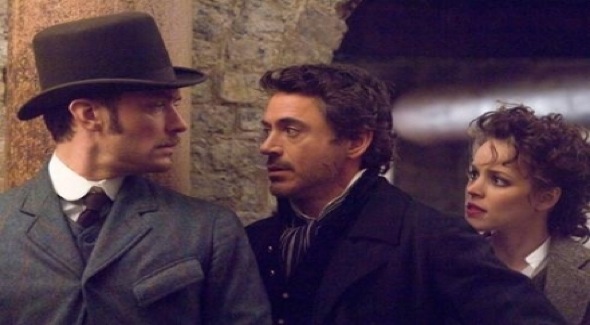
Since 1908, Hollywood has been churning out adaptations of Sir Arthur Conan Doyle’s Sherlock Holmes stories. Every portrayal detective in literature, film or television harkens back to 221B Baker St. (51° 31’25.50” N, 0° 09’30.89” W)* for those seemingly insignificant details, the flawed but determined investigator, and the big reveal at the end. Even medical shows are cheating off Doyle these days.
With examples ranging from the fabulous (Basil Rathbone, both on film and on the radio) to the awful (much of the Young Sherlock Holmes series), Holmes and his stories are well trodden territory, but there’s hope for tomorrow’s film will have something new. For the first time, we’ll get see Sherlock Holmes portrayed as a superhero by Robert Downey Jr., an actor who plays a good superhero.


People go to the movies for a variety of reasons: escape, catharsis, inspiration, a date, an air-conditioned room on a muggy Sunday afternoon. Rarely do we go in order to learn something. And we’re okay with that. We sacrifice science and accuracy in the name of entertainment. Hollywood has a hard time getting physics right: do bullets spark when they hit a metal surface? Can a bus traveling at 55 MPH jump a forty-foot gap? And just how long does it take a kid to fall from Niagara Falls, anyway?
But Hollywood has an even harder time depicting genius.
By “genius” I don’t just mean exceptional technical ability or artistic talent. I mean that insane burst of creativity that breaks conventional boundaries. A genius is not just someone smarter than us, but someone so much smarter that we can’t even recognize what they’re doing. The word genius itself, in Latin, refers to a guardian spirit; someone who created a great work was said to be inspired by such an entity. “Talent hits a target no one else can hit,” wrote Schopenhauer. “Genius hits a target no one else can see.”
To put it concretely: every heist movie has its techie guy. Every Bohemian romance has its tortured artist. Every business drama has its self-made billionaire. These people are not geniuses. The fact that we can recognize the tropes they inhabit proves it. Richard Feynman was a genius. Leonardo DaVinci was a genius. Warren Buffett is a genius. And I submit that Hollywood could not produce a satisfactory depiction of them.
Why do I say that? Let’s look at a few examples.