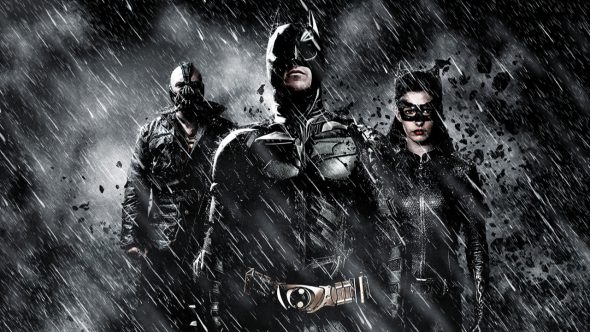
To coincide with the DVD Release of The Dark Knight, here’s a look back at some of our Overthinking™ on the subject.

Video

The Philosophy of Batman

LOLJokers

General Overthinking

Quantum of Solace Trailer

In a world beset by corruption, only one man, playboy by day and above-the-law action hero with access to unbelievable riches and technology by night, can take on a massive criminal syndicate, despite the misgivings of an older, better actor, to avenge a woman he loved and lost.

Sound familiar? Oh yeah, it’s The Dark Knight almost exactly (though this time, the older, better actor is a woman).

The incredible financial success of The Dark Knight has virtually guaranteed that we’re going to be seeing a lot more of this phenomenon — which I’m going to call Batmanization (either that or Nolanization; haven’t decided yet): a pervasive darkness in mood and tone, moody, inscrutable heroes that, even when they are state-sponsored, come off as vigilantes, and, judging by this trailer anyway, very little emphasis on sex, which I find shocking in a Bond film.

Agree? Disagree? Sound off in the comments.

Wrather, Fenzel, Sheely and Stokes overthink The Dark Knight.

Download Episode 10 (revised) in AAC Format

UPDATE (2008-08-08): Spoilers related to (of all things) The Wire were inadvertently included in this podcast. They have been removed, and the link above has a spoiler-free edition of the podcast.

Yahoo SeriousEvery asshole with a cable modem thinks he can make a mint on the internet by selling useless crap. (Real grade-A douchebags call this a passive income muse. No joke.)

Why should be any different? Introducing the first offering of the Overthinking It Store. Buy quick, before this combination of memes expires, or before we get a cease-and-desist order from Mr. Serious. I give it 72 hours.

loljokerz!

posted by sheely on Friday, August 1st, 2008 at 6:40am

Want to join the fun? Check out the LOLjoker contest rules and guidelines.

Submitted by Mlawski

Many, many more entries after the jump!

Over the past two weeks, much digital ink has been spilled about the political meanings and messages embedded in The Dark Knight. In this particular corner of the intertubes, considerable (over)thought has gone into dissecting the layers of philosophy in the film. However, looking closely at the intersection of the two reveals that the filmmakers pose some very important questions that probe the very nature and origins of social and political order.

No spoilers here, so read on, even if you haven’t seen the film yet.

JK!

Words only after the jump, so if you’re just here for the LOLJoker, read no further…

Got a loljoker of your own? Email it to sheely AT overthinkingit DOT com before Sunday, August 3, 2008 at Midnight EDT. The best one wins a vintage batman t-shirt, and we’ll invite you onto the OTI Podcast to overthink some stuff with is. Rules and guidelines »

“Haha, now I REALLY want to know what The Dark Knight has to do with Schopenhauer.”
-mlawski

Alright. You asked for it.

Batman, Schopenhauer Style

Mlawski’s own fine post on utilitarianism and The Dark Knight, “The Philosophy of Batman” inspired me — can we delve deeper into the philosophy at the heart of The Dark Knight? I figured I’d go to the well and hash out some German philosophy for this one, partially because I thought it fit, and partially because, like Bruce Wayne, I’m just that crazy.

Now, that time is upon us, and you can decide whether or not I was wise.

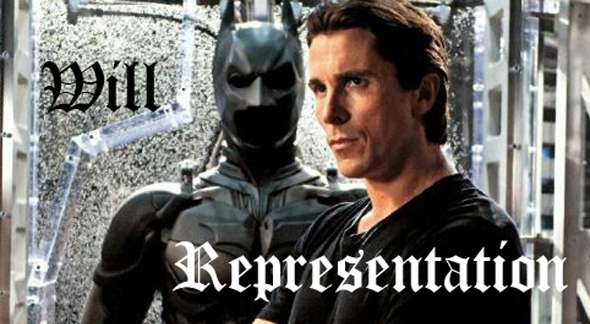
Find out about more about the WIll-to-Batman and the Will-to-Joker, after the jump –

The Joker’s Magic Pencil

posted by fenzel on Saturday, July 26th, 2008 at 8:49pm

Thanks for visiting Overthinking It, where we take movies, tv, music, comics, and videogames waaaaay too seriously.

While you’re here, check out our other articles, or just the ones about movies.

And check out our podcast (iTunes link).

If you like what you read, you can get all the latest posts by RSS or by email.

THERE ARE HUGE THE DARK KNIGHT SPOILERS IN THIS POST. BE WARNED!

I WILL ALSO PUT A RANDOM STEVEN SEAGAL MOVIE SPOILER AT THE END OF THIS POST. GET EXCITED!

If you’ve seen it, you’ve talked about it. Maybe you cringed. Maybe you cried out. Maybe it totally surprised you, or maybe, like me, you’d heard a little bit about it, but when it actually happened, it still surprised you, and you still cringed, and maybe you still cried out a bit, but you’d rather not draw attention to that, so you won’t mention it except in your blog.

Because, sure, Christopher Nolan’s latest Batman film is a dark and compelling exploration of the moral hazards of political necessity. It’s a brave reinvention of the superhero genre. It’s a Boffo Box-office Breaking Batnanza (as Variety might put it if they felt feisty).

But mostly, it’s two-and-a-half hour framing device for a really disturbing scene with a pencil.

You know it’s true. Find out what makes the Joker’s pencil so magical after the jump —

(There Will Be Spoilers)

Christopher Nolan didn’t major in philosophy in college (or “read philosophy at University,” as the case may be), but he evidently has some familiarity with the subject.  How do I know?  Well, both of his two Batman films thus far have featured famous philosophical thought experiments.Just kill the ugliest one.

In Batman Begins, we have the well-known trolley experiment, in which a person must imagine that s/he is on a trolley that is barreling down the tracks towards five people (or babies, depending on if your ethics professor is more or less of a sadist) who are tied onto the tracks.  The imaginer can then either imagine that s/he pulls a lever, switching the trolley onto another track that only has one person (or baby) tied to it, or that s/he does nothing, allowing the trolley to kill the aforementioned five.  The utilitarian will say, “I switch the trolley to the new track, because it’s better to kill one person than to kill five.”  The non-utilitarian will say, “I leave the trolley to kill the five, because at least then I am not morally at fault.”  The main ethical question is: “Is there a difference between killing a person and letting a person die?”