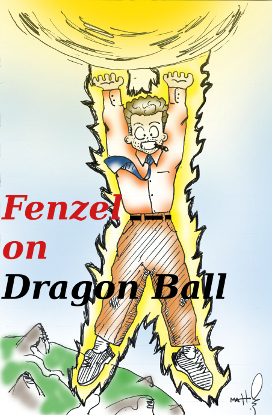
 As we’ve established in parts #1 and #2 of this 48 part series, there are a lot of things I love about Akira Toriyama’s Dragon Ball. The disheartening arrival of the abomination Dragonball Evolution dulled my enthusiasm for a time, but I feel it flowing back into me, raisin’ the ol’ power level back up to arbitrary numbers.
Anyhoo, one of these things I really love about Dragon Ball is that its elegant, elemental narrative style and clear characterization make it easy to notice the wide variety of tropes, motifs and other devices that Toriyama uses to guide and develop his storylines. It has the epic Brechtian quality of a theatrical production where you can see the wires and the lighting equipment, without breaking the emotional identification and welcoming effortlessness of Stanislavski’s “Magic If.”
So, taking a bit of a break from using everything else I know to try to explain Dragon Ball, today I will use what I know about Dragon Ball to explain something else. Namely, one of the most useful and interesting distinction in parts of speech across poetical and literary systems, and also one of the most neglected in the casual enjoyment of art.
Today’s battle in the expansive desert, full of its elaborate rock formations that all produce prodigious dust clouds upon their destruction?
Metonymy and Metaphor. If these are things you’re not 100% solid on, read on, increase your literary power level, and actually learn something pretty simple that will help you enjoy art and lesser things you already like all the more. Because they’re certainly using it . . .
Today’s discussion starts with two fairly intuitive Dragon Ball special moves, the Kaioken (Fist of the Kais or Fist of the Worlds) and the Taio-ken (Fist of the Suns) — keep in mind that, despite my choice of video clips, here I must rely on what I get out of the English — this is not a canonical discussion of the original Japanese, because I DON’T SPEAK JAPANESE!
This is the Taio-ken. The taio-ken is an example of Metaphor.
The taio-ken converts life energy into a bright flash of light that blinds the opponent.
This is the Kaio-ken. Kaio-ken is an example of Metonymy.
http://www.youtube.com/watch?v=TuYrvWPmyj0&feature=related
The kaio-ken puts one’s body under tremendous strain in order to multiply one’s strength.
Metaphorical comparisons are similar, whereas metonymical comparisons are contiguous.
The Fist of the Suns is so named because it produces an effect that is like the sun — it’s really bright and blinding. Tenshinhan, the guy who first uses the move, isn’t associated with the sun. He never went to the sun. Nobody lives on the sun in Dragon Ball, and the sun doesn’t get referenced much in Toriyama’s work (the moon, on the other hand . . .). He just happens to have a move that’s like the sun, so it has a metaphorical name that reflects that relationship.
Conversely, Goku learns the Fist of the Worlds from King Kai, one Dragon Ball’s wacky deities, in the afterlife. At the cost of giving up his body for a time, Goku is put under tremendous strain on a planet with ten times normal gravity and learns how to multiply his strength.
Now, King Kai never gets in any fights, he isn’t nearly as physically strong as the protagonists, and he looks like this:
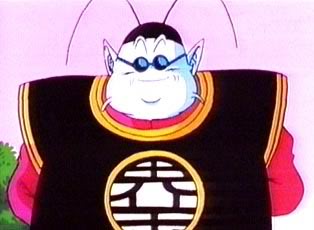
So, the kaio-ken doesn’t make you similar to King Kai. It’s his move, so it’s named after him, but he’s also a diety, and its name implies godlike power that isn’t natural in the human world (thus, mortals can’t easily handle it).
And the Fist of the Worlds doesn’t make you similar to a world. But it reflects both the extraterrestrial scope of the power levels involve, and it reminds you that this is the kind of move you don’t get to learn if you stick around on your own planet. It talks a bit about the history of the move, the things that are associated with it.
These two explanations fall within a close range of ideas that would be grouped together under the umbrella of “King Kai and his stuff.”
 Other things that would be contiguous with King Kai would be Bubbles the chimp, Gregory the cricket, his little house and his classic car.
It’s notable that King Kai is not the only Kaio in Dragonball (far from it) – otherwise, the Kaio-Ken would lose some of its metonymical quality. Being a Kaio isn’t just a namesake, it’s another quality that is contiguous with being King Kai.
It seems pretty intuitive by this example; the word contiguous is what gets in the way of understanding it most of the time. But people refer to things that are part of the set of “so and so and his stuff” all the time, and it feels a lot different from a metaphor.
For example, if you compare Randy Moss to Gisele Bündchen, that isn’t metaphor, it’s metonymy, because these are both people who are contiguous with Tom Brady. You could even compare Gisele to Kate Moss and in turn to Randy Moss, but that sort of fleaflicker trick play only works in the movies.

Metonymy: “This is one randy receiver.”
And if you compare Tony Soprano and Tonya Harding, it might be a metaphor, because they’re both criminals, but it’s more likely metonymy, contiguous with the set of “stuff associated with hitting people in the kneecaps.”
It’s easy to write this off, but I think it’s an important, useful distinction, and I think Dragon Ball highlights it. In Dragon Ball, metonymy tends to beat metaphor. Things that boast similarity carry less of a weight of legitimacy than things that are contiguous. The kaio-ken is just plan stronger than the taio-ken. Cell, who is actually engineered from the genes of the heroes, is stronger than the androids, who are simply programmed to have similar powers. When Gohan uses attacks that remind him of his father in the end of the Cell Saga, he’s much more effective than when he dresses in his father’s costume, as in near the end of the interminable Majin Buu Saga.
What, do you think I’d leave you with just that? Oh, wait, there’s more!
Synecdoche and simile
Scholars.
Not all contiguous renamings are best described as metonymy, and not all discontiguous ones are best described as metaphor. Synecdoche and simile are, depending on who you ask, either subsets of or slight variations on metonymy and metaphor.
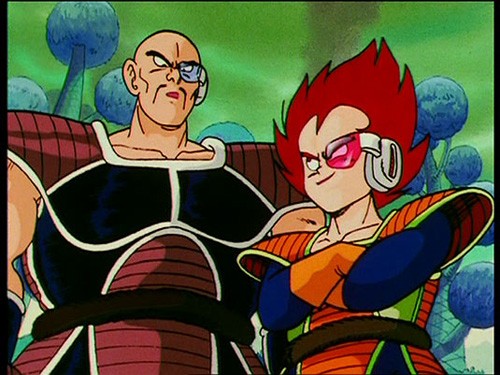
When a character is referred to by power level (again, an arbitrary measure of strength used as a stakes-raising device), as when Nappa smugly refers to Goku as “a 5,000,” that’s synechdoche. “A power level of 5,000” is part of the set of things that are “stuff related to Goku at this point in the story.” But more specifically, it’s one part or aspect of Goku. This becomes increasingly silly and eventually stops — moving away from understanding or referring to people by their power levels — moving away from synechdoche as a mode of comparison, to judge people by more than the sum of their parts — is one of the big idea-driven arcs of the Frieza saga.
All part-to-whole relationships are contiguous, but the mental leap to contiguity is not as illustrative; it doesn’t carry as much information. We have to make a bigger leap of contiguity to understand “The First of the Worlds” than to understand “a 5,000,” so the tropes, while related and perhaps subordinated, have different names.
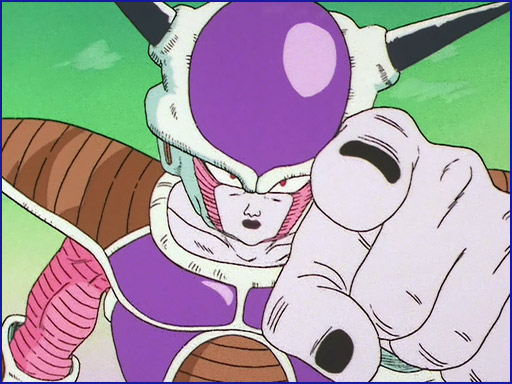
Simile is the form of comparative renaming that is most frequently taught in schools, because it is the most systematic. The best example of it in Dragonball is when Frieza says to the unlikely team of Gohan, Krillin and Vegeta before the arrival of Piccolo or Goku, in reference to the three minor characters defeating him, that “Sure you can, just like three ants can beat a dinosaur.”
Of course, Frieza has nothing to do with dinosaurs, he is just very strong and imposing. So it’s a relationship of similarity, not contiguity.
And, of course, there aren’t a lot of good examples of this in Dragon Ball, because it’s an English trope and Dragon Ball was written in Japanese — and also because Dragon Ball characters don’t tend to themselves speak in metaphor as much as they tend to represent metaphors.
It’s a very “show, don’t tell” kind of story. Sometimes.
The Many Flavors of Vegeta-related Irony
Proud.
Ah, irony, that finest of tropes: When things happen in a way opposite to your expectations.
Dragon Ball is great at helping us understand irony, because it gives us a character who is thoroughly incapable of coping with it. So, whenever irony, you get a lot of screaming and big flashing lights and arrows pointing to it.
Of course, I am talking about Vegeta, Prince of All Saiyans who is kind of an ornery homeless drifter with bad clothes. Over 24 volumes of manga, ther super-powered alien who insists he is the strongest being in the universe never wins any fights except against his own paraplegic sidekick, Frieza’s weakest henchmen, a lot of innocent civilians on several occasions, and a random fat robot.
Yeah, he gets his ass kicked a lot, and he makes a lot of really stupid mistakes.
He also insists that he is a villain for most of the story, despite the fact that it is very obvious that he’s going to turn out to be a hero.
He is also relentlessly hubristic to the point of parody.
Here, as a fun little memory tool, are many of the different kinds of irony, each of which Vegeta blasts out loud and clear at one point or the other.
Dramatic irony (the audience knows something the character does not) — When Vegeta comes across Gohan on Planet Namek, the young boy is hiding a stolen dragon ball behind him. In a rare moment of mercy, thinking he has all seven dragon balls and doesn’t need to, Vegeta decides not to kill Gohan. Thus, he loses the dragon ball and is eventually killed.
Situational irony (causes have the opposite of their expected effects) — In his urge to fight someone who will truly challenge him and prove his superior strength, Vegeta lets Imperfect Cell merge with Android 18 and thus transform into Perfect Cell. The resultant Perfect Cell is so far out of Vegeta’s league that he doesn’t even get to fight him at the Cell Games.
Verbal irony — Vegeta is a self-important, sarcastic jackass for about ten years of cartoons and comic books. “What happened to the great and mighty X? Come on, X, fight me! Show me how GREAT you are. REALLY.”
Tragic irony — Vegeta kills himself to kill Majin Buu and save his family, not knowing that by killing himself and removing the possibility of fusing with Goku to fight Buu together, he has removed one of the world’s only hopes for survival. This leads directly to the death of his wife, son and rest of the human race.
Irony of fate or cosmic irony (destiny is predestined to be the opposite of expectations) — Vegeta constantly harps on how it is his fate and destiny to be the strongest fighter in the universe and the strongest member of the Saiyan race. But Toriyama’s plots are pretty well telegraphed, and by the time Vegeta rolls around, Goku is the protagonist who is pretty much guaranteed to always be the strongest character in the story, with only a few exceptions. So Vegeta’s destiny is actually always to be the weaker one.
Historical irony (real world events play out in the opposite of historical expectations) — Despite hating most people most of the time, including the heroes, the human race, and his own family, despite being hostile and antisocial, despite insisting on living in seclusion and anonymity, despite trying to destroy the earth and killing the spectators at his fights, and despite never touching his wife in the comic book or show and being entirely devoid of affection or tenderness — in the real world, Vegeta is a fan favorite and the subject of a great deal of erotic fanfiction.
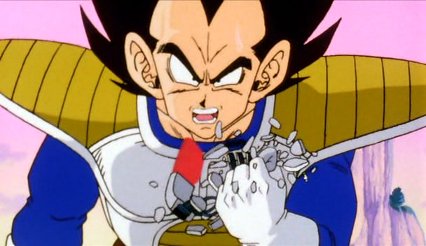
See, Vegeta, it isn’t impossible, because it just happened. That’s how you know it isn’t impossible. Because it happened.
More types of irony? Favorite parts of speech? I know I haven’t done chiasmus or zeugma yet, but there are 45 more parts to this series I have to get to! If I did everything in a timely manner, it wouldn’t be Dragon Ball, now would it?
Oh, and this clip has like five or six different examples of Vegeta-related irony.
http://www.youtube.com/watch?v=vJzH1Lu5wbo
Can you find them all? Sound off in the comments!
It’s over 9000!!!
My favorite post in a while, I had not realised until now what a truly tragic figure Vegeta is until now. A few random overthought DBZ-related questions (which could probs be entire articles by themselves) that occurred to me while reading this:
1. Does it say something about society, demographics, focus grouping or w/e else that Goku is essentially the world’s first mentally handicapped superhero? (take a look at him in the episodes when he’s not fighting, clearly the knock on the head as a baby’s had some pretty major effect)
2. Is Dragonball Z (android saga onwards) a modern-day version of ancient mythology in the style of the greeks, romans, ejyptians, norse, etc? Think about it, a place above the world full of incredibly powerful people, seeing everything, squabbling amongst themselves. A whole variety of personality flaws and secret agendas and rivalries and such, with noone to regulate them except each other… Actually this could also be the real world version of that parody “Saturday Morning Watchmen”.
3. Beyond the obvious homoerotic undertones to it, I think the whole fusion thing in the Buu saga could be a good topic for overthought. Did anyone notice that Gotenks was essentially an experiment in taking the worst of both Goku and Vegeta? Things like Goku’s playful carelessness, lack of critical thought and naivety with Vegeta’s narcissism, power lust and rage, and representing that peak of immaturity and stupidity by making their fusion be by the proxy of their sons. This is particularly interesting when you consider that Vegeto was a combination of everything that is best about each and he can only be created when each can fully understand and respect the other’s strengths, and that this is the reason why Gotenks fails and Vegeto succeeds.
Also, the video at the end is broken…
Hii!! I am a long time reader from Chile (South America, long and thin country) It was a great reading, thanks a lot. Maybe I am asking too much but, Would it be posible that you could post or send a email of the books that you where using to get those definitions (The dramaticals ones) ???
Thanks again, and thanks for the site.
Your last video broke. What was it?
Dragon Ball Kai, m’dear: http://dragonball.wikia.com/wiki/Dragon_Ball_Kai
Oh my, and you can watch it, too…
http://dbkai.net/episodes